
.png)
How to Secure Hand Embroidery on Clothes for Lasting Luxury
Buying a hand-embroidered garment is a little like choosing a handcrafted heirloom over a factory-made souvenir. The beauty catches your eye first, but the unseen details decide whether it will last for years or disappoint after a few wears. Among real buyer concerns, loose threads remain one of the most memorable complaints because they raise doubts about true craftsmanship. Knowing how quality embroidery is secured helps you choose clothing that carries lasting elegance, cultural meaning, and confidence.
Why does hand embroidery on clothes come loose even when the design looks well stitched?
Hand embroidery on clothes usually comes loose because 3 stress points—fabric movement, unbalanced stitch tension, and unsecured thread ends—were hidden behind a neat front.
For how to secure hand embroidery on clothes, durability starts at the reverse side: the fabric must stay stable, stitch density must not overload the cloth, and beginnings/ends must be anchored without pulling the ground fabric. Amefird advises tie-in/tie-off stitches and reduced density at stress points; the Canadian Conservation Institute warns that excessive tension creates buckling or gathering.
Loose stitches often come from weak anchoring; visible thread tails, long back floats, or chaotic reverse-side trails are red flags. Stretchy knits and thin T-shirts distort because the fabric relaxes after hooping, washing, or wear. Dense motifs can look luxurious on day one but later pucker, feel stiff, snag on jewelry, or make the garment look cheaper after a few wears.
The limit: a flat front alone cannot prove durability; the back, fabric recovery, and care method decide long-term elegance.
That technical failure becomes a gifting risk when the recipient sees loose loops before they see craftsmanship.
I’ve seen the anxiety behind this: a shirt or dress looks beautiful in the shop, then after washing, petals lift, the fabric ripples, or the back scratches the skin. That tiny loose loop becomes a reputation problem. For a VIP gift, I would not trust only the front. I would check the reverse side, feel for bulky knots, and gently stretch the fabric to see whether the embroidery returns cleanly.
Key Takeaway: Secure hand embroidery is not “tighter knots”; it is balanced tension, stable fabric, clean anchoring, and care that preserves the garment’s dignity.
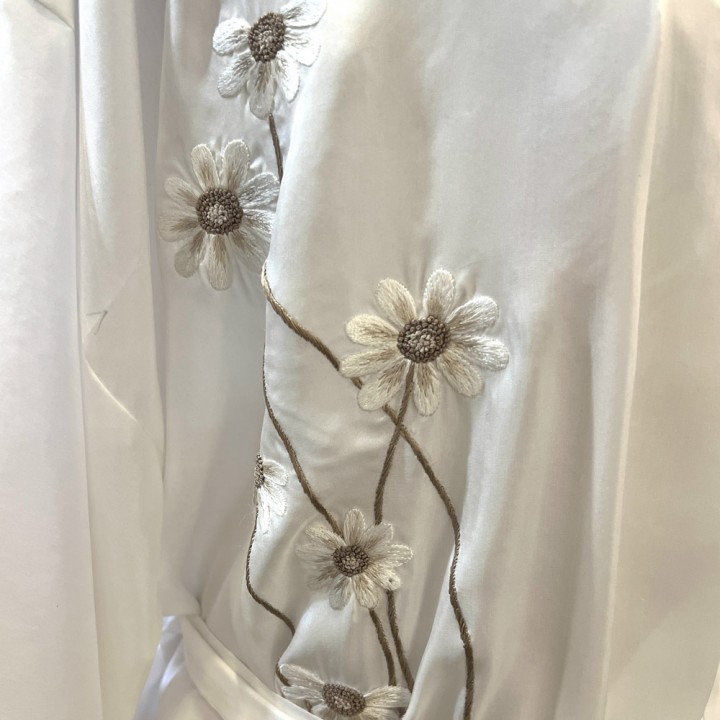
What should you check before securing embroidery on silk, linen, cotton or áo dài fabric?
Before deciding how to secure hand embroidery on clothes, check 4 risks first: weave stability, fabric weight, stitch density, and care tolerance.
| Fabric | Check before securing | Red flag | Decision meaning |
|---|---|---|---|
| Silk | Test needle holes, puckering, sheen damage, and light interfacing. Silk looks ceremonial but needs controlled tension and gentle handling. | Permanent holes, water spots, hoop marks. | Best for refined áo dài, heirloom gifts, and light motifs; not ideal for dense filling without backing. |
| Linen | Check even weave, slubs, bias movement, and fabric weight. Linen supports clean stitches when the weave is firm. | Loose weave or large weak slubs. | Strong choice for elegant, breathable gifts with visible craft character. |
| Cotton | Hold to light, test shrinkage, and prewash a sample. Tight cotton and poplin usually secure embroidery better than gauzy cotton. | Thin cloth, diagonal distortion, shrinkage after washing. | Good for durable, lower-maintenance embroidered garments. |
| Áo dài fabric | Check drape on a hanging sample, transparency, motif placement, and backing visibility. | Stiff embroidery at bust, waist, or hip. | Luxury depends on both fabric beauty and movement, not fabric prestige alone. |
Boundary: a luxurious fabric can still fail if the embroidery is too dense, the backing is visible, or the garment care does not match the recipient’s lifestyle.
For a VIP gift, the safest question is not “Which fabric is richest?” but “Will the embroidery still look calm, flat, and intentional after wearing, washing, and gifting?”
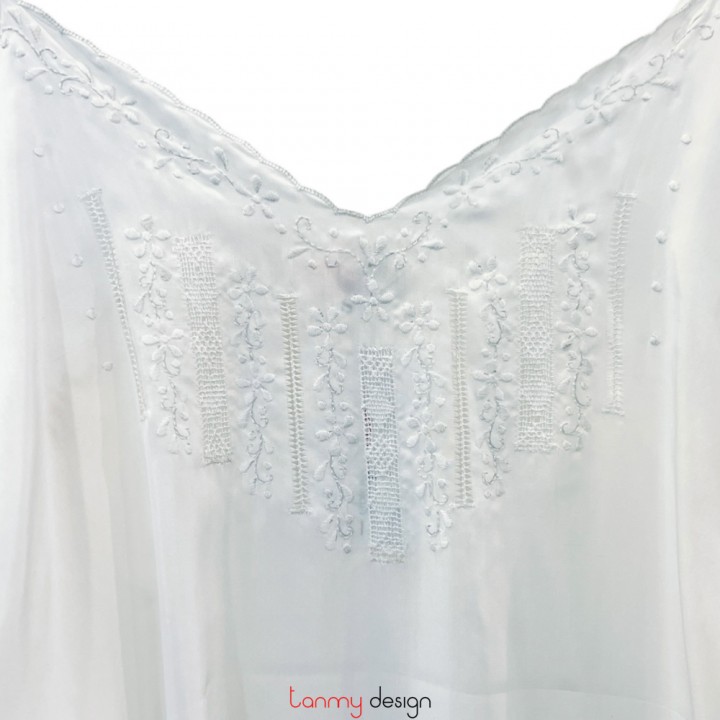
How do artisans secure the back of hand embroidery without making the garment feel bulky?
Artisans secure hand embroidery on clothes by anchoring thread ends first, then adding only the thinnest backing or lining needed to stop snagging and skin irritation.
The best reverse-side finish uses 3 controls: woven thread tails for low bulk, tiny anchoring stitches instead of hard knots, and light backing fabric only where the motif needs abrasion protection. Weaving tails keeps the back flatter than knots; anchoring stitches spread stress across several stitches; soft backing or lining separates skin from rough thread ends (Madeira; Emblibrary; Sewing Beginners).
For luxury garments, the rule is not “more backing,” but minimum reinforcement: dense motifs, stretch fabrics, or high-friction zones may need stronger support, while silk, sheer, or lightweight pieces need restraint to protect drape and avoid show-through.
This method cannot hide poor stitch planning; if the motif is too dense for the fabric, even careful backing may still create stiffness or puckering.
For a VIP gift, the unseen back often decides whether the piece feels truly handmade or merely decorative.
I notice this most when I turn a garment inside out before gifting it. A beautiful front can lose its confidence the moment my fingers meet a hard knot or scratchy patch near the chest. That is bulk control: the difference between fabric that moves softly and embroidery that feels like a hidden plate. For a formal gift, I want the recipient to feel refinement before they ever ask how it was made.
Which 5-step luxury framework helps hand embroidery stay secure after wearing, washing and gifting?
Use LUXE-5 to secure hand embroidery on clothes through 5 checks: front/back inspection, fiber verification, care testing, occasion fit and provenance.
- Look: inspect the front and reverse; hand embroidery may show slight human variation, while machine work often shows rigid uniformity, carried threads, or bulky backing.
- Understand materials: verify base fabric, thread fiber, lining, stitch density, and stabilizer; weak fabric or synthetic thread can make a gift look stiff after wear.
- eXamine care: ask for embroidery-specific care, not only the garment tag; use cool water, mild detergent, inside-out washing, no wringing, air drying, and protected ironing.
- Evaluate craftsmanship: check shading, motif placement, stitch tension, and reverse neatness; luxury embroidery should feel refined, not fragile or scratchy.
- Fit the occasion and evidence: match motif restraint to the event, then keep receipts, artisan notes, certificates, or care cards as gift provenance.
This framework cannot guarantee durability if the garment is frequently abraded, tumble-dried, bleached, or made on unstable fabric.
For a VIP gift, care proof matters because the buyer is not just buying beauty; they are buying confidence.
I once hesitated over an embroidered gift because the photos looked elegant, but the reverse side was never shown. That missing view triggered the real fear: would the recipient feel rough backing on the skin, or see loose threads after the first wash? A simple check for stitch density (how tightly the thread holds the motif) and a written care card would have changed the decision from “risky” to “worthy.”
Key Takeaway: LUXE-5 turns how to secure hand embroidery on clothes into a buyer-safe checklist for authenticity, durability, and prestigious gifting.

How should you wash and store hand-embroidered clothes so the gift keeps its ceremonial value?
Hand-embroidered clothes keep their ceremonial value when washed cold, handled by hand, dried without heat, and stored cool, dry, dark, and cushioned.
- Wash gently: Use cold water and mild, bleach-free detergent; this protects thread color, base-fabric shape, and reverse-side knots.
- Avoid force: Do not scrub embroidery, wring wet fabric, tumble dry, or dry under direct sun; heat and twisting can cause puckering, fading, loose loops, and distorted motifs.
- Finish carefully: Press water out with a towel, air-dry flat or supported, then iron only from the reverse side on low heat with a pressing cloth.
- Store like an heirloom: Fold softly, avoid sharp creases across embroidery, place acid-free tissue between folds, and keep the garment away from humidity, plastic, jewelry, zippers, and long-term hanging.
For silk, metallic thread, beadwork, velvet, lined garments, or antique embroidery, washing may not be safe; spot cleaning or a textile specialist is the lower-risk choice.
For a VIP gift, care is not an afterthought. It protects the moment after the ceremony: the quiet fear that one wrong wash will turn a meaningful Vietnamese hand-embroidered piece into something ordinary.
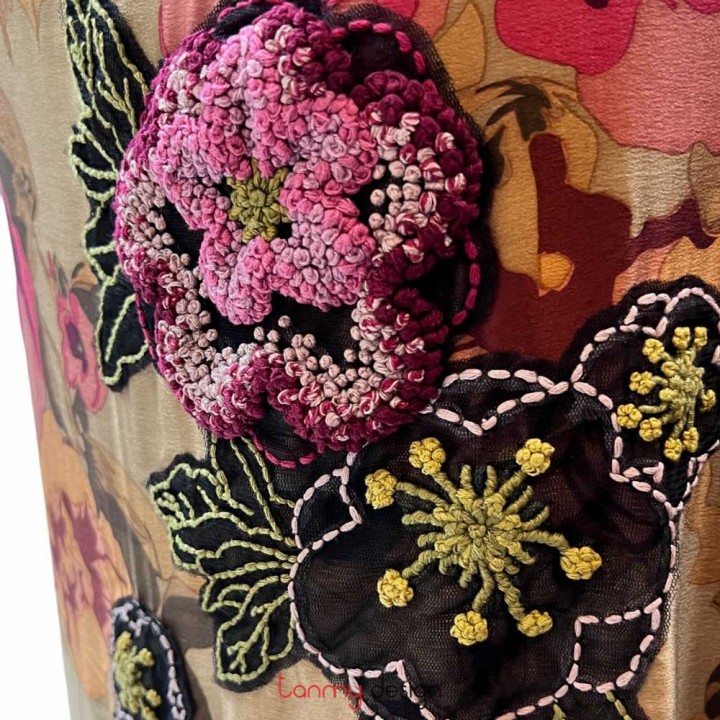
When should you choose professionally finished hand embroidery instead of securing it yourself?
Choose professionally finished hand embroidery when the garment carries VIP, cultural, or long-term display value, because 4 risk signals outweigh DIY control: finish, provenance, timing, and presentation.
| Decision signal | Choose professional finishing when… | Evidence to check | Decision meaning |
|---|---|---|---|
| Gift occasion | The garment is for a partner, VIP, wedding, corporate ceremony, or representative event. | Event brief, recipient status, deadline, display context. | Imperfect securing can make the gift feel casual instead of ceremonial. |
| Craftsmanship risk | You cannot verify tension, reverse-side neatness, puckering, thread trimming, or stitch stability. | Close-up front/back photos; stitch-path inspection; test wear or wash. Needle ’n Thread notes that back-side thread paths can reveal machine-like or inconsistent execution. | Professional finishing reduces visible amateurism and post-gift failure. |
| Provenance claim | The gift is presented as Vietnamese hand embroidery or artisan-made. | Maker profile, process images, studio record, artisan proof. Provenance treats artisan-producer claims as trust claims tied to traditional craft skill. | Provenance protects the gift from feeling mass-produced or hollow. |
| Reputation risk | The recipient’s judgment affects business, family, or brand trust. | Packaging, care card, quality-control record, presentation standard. Diplomatic-gift analysis shows symbolic gifts can carry national craft, reputation, and accountability weight. | The finish becomes part of respect, not decoration. |
DIY is reasonable for practice pieces, casual wear, or low-stakes personalization; it is unsafe when failure would be visible, public, or difficult to repair.
The real question is not only how to secure hand embroidery on clothes, but whether the garment must carry confidence the moment it is opened.
A VIP buyer often hesitates at the final inch: the cloth looks beautiful, but one loose thread, uneven backing, or thin box can make the whole gesture feel smaller. In high-end gifting, the hand does not only see beauty; it feels weight, smoothness, stillness, and care. Professional finishing turns craftsmanship proof into quiet reassurance: the gift can be touched, worn, displayed, and remembered without the giver silently worrying that it looks like a personal experiment.
A secure embroidered garment is never judged by appearance alone. Fine stitching, thoughtful finishing, and proper care work together to preserve its beauty over time. At the same time, no handmade piece is flawless, and an occasional loose thread does not always signal poor craftsmanship. The wiser question is whether the embroidery was finished with skill and respect for the artisan's work. If you're searching for an authentic Vietnamese gift that reflects heritage and enduring quality, explore the curated hand-embroidered collections at Tân Mỹ Design to see craftsmanship before you decide.
FAQ
How to secure hand embroidery on clothes for lasting luxury?
Secure hand embroidery by knotting thread ends neatly, using suitable backing, avoiding loose floats, and washing by hand or on a delicate cycle in cold water.
How do I wash hand-embroidered clothing?
Use cold water, mild detergent, and gentle hand washing. Turn the garment inside out and avoid wringing, bleach, or heavy machine spinning.
Can embroidered clothes be machine washed?
Yes, but only on a delicate cycle, inside a mesh laundry bag, with cold water. For silk, linen, or heirloom-quality Vietnamese embroidery, hand washing is safer.
How do I stop embroidery from unraveling?
Check the back of the embroidery. Loose thread tails should be secured with small stitches or fabric-safe backing, not glue on visible luxury fabric.
Should I use stabilizer or backing?
Use backing when the fabric is thin, stretchy, or likely to rub against skin. The backing should support the stitch without making the garment stiff.
What is the biggest care mistake?
The main risk is heat: hot water, tumble drying, and direct ironing can weaken thread tension, distort fabric, or flatten raised hand embroidery.
Other articles
Vietnamese Silk Scarf Motifs: Meanings & Gift Choices
Square vs Long Silk Scarf: Which Makes a Better Gift?
Hand-Embroidered vs Printed Silk Scarves: Which to Gift?
_cr_720x720_cr_336x264.jpg)
Meaningful Personalized Gifts: What Makes Them Feel Truly Special




Add: 61 Hang Gai St., Hoan Kiem Dist., Hanoi, Vietnam
Hotline: +84 936631368
Email: info@tanmydesign.com