

How to Choose Tablecloth Size: Measure, Calculate & Fit
To choose the right tablecloth size, measure your tabletop and add twice your desired drop to each relevant dimension. A 6–12-inch drop suits everyday dining, while a longer drape creates a more formal appearance. Whether your table is rectangular, square, round, or oval, the final choice should balance your preferred look with the actual finished sizes available, rather than relying on measurements alone.
How to measure your table for a tablecloth
To choose the right tablecloth size, measure the tabletop at its widest relevant points, select your preferred overhang (known as the drop), and add twice that drop to each tabletop dimension. Follow these steps:
- Measure your tabletop. Use a tape measure laid flat across the surface. Record dimensions in inches or centimeters, keeping the same unit throughout.
- Rectangular: Measure the length and width along the tabletop edges.
- Square: Measure one side.
- Round: Measure the diameter from edge to edge through the center.
- Oval: Measure the maximum length and width through the center.
- Choose your preferred drop. A drop of approximately 6–12 inches (15–30 cm) suits many everyday settings. A longer drop can create a more formal appearance.
- Calculate your tablecloth size. Add twice the desired drop to each relevant dimension:
- Rectangle or oval: (Length + 2 × Drop) × (Width + 2 × Drop).
- Square: Side + 2 × Drop, for both dimensions.
- Round: Diameter + 2 × Drop.
- Check extendable tables. Measure both closed and extended configurations. Choose your tablecloth based on how you normally use the table.
- Account for unusual shapes. For asymmetrical or custom-fitted tables, record additional measurements or provide a paper template to the linen maker.
Example: A 72 × 36-inch rectangular table with a 10-inch drop needs a 92 × 56-inch tablecloth.
Before purchasing, compare your calculated dimensions with the actual product measurements rather than relying on seating capacity alone.
How much should a tablecloth hang over the edge?
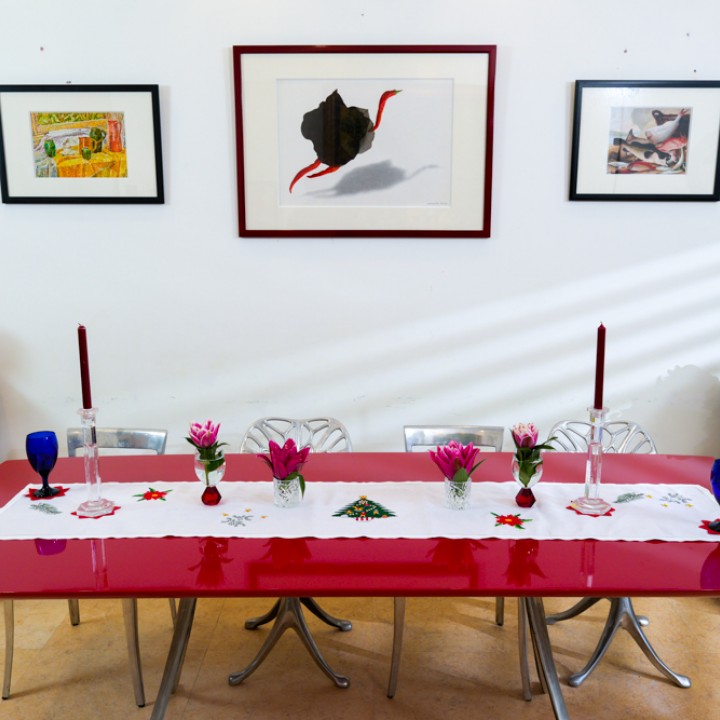
A tablecloth should generally hang 6–10 inches (15–25 cm) over each edge for casual dining, 10–15 inches (25–38 cm) for formal dining, or nearly to the floor for decorative displays. The ideal overhang, called the tablecloth drop, depends on your table's height, seating arrangement, and desired appearance.
Choose your drop based on how you use the table:
| Setting | Recommended drop | Appearance |
|---|---|---|
| Casual dining | 6–10 in (15–25 cm) | Relaxed, practical, with visible table legs |
| Formal dining | 10–15 in (25–38 cm) | Elegant, balanced draping |
| Decorative or event display | Approximately 29–30 in (74–76 cm) on a standard-height table | Floor-length coverage that conceals table legs |
These are flexible styling conventions, not universal standards. Published tablecloth sizing guidance distinguishes between everyday, formal, and floor-length drops, while recommended ranges vary between guides.
To calculate your tablecloth size, add twice your chosen drop to each tabletop dimension:
Tablecloth dimension = Table dimension + (2 × Desired drop)
For example, a rectangular table measuring 60 × 36 inches with a 10-inch drop requires an 80 × 56-inch tablecloth.
For seated dining, check that the fabric does not interfere with chairs or guests' legs. For floor-length styling, measure the actual table height rather than assuming 30 inches, and allow a small gap above the floor to prevent dragging.
The best fit combines the appearance you want with comfortable, practical use.
How to calculate tablecloth size for different table shapes
To calculate the right tablecloth size, measure your tabletop and add twice your desired drop to each dimension. The drop is the fabric hanging below the table edge. The calculation depends on whether your table is rectangular, square, round, or oval.
- Rectangular tables: Measure the length and width, then add twice the drop to both dimensions.
Formula: (Length + 2 × Drop) × (Width + 2 × Drop)
Example: A 180 × 90 cm table with a 25 cm drop needs a 230 × 140 cm tablecloth. - Square tables: Measure one side and add twice the drop.
Formula: Side + 2 × Drop
Example: A 100 × 100 cm table with a 20 cm drop needs a 140 × 140 cm tablecloth. - Round tables: Measure the diameter through the center and add twice the drop.
Formula: Diameter + 2 × Drop
Example: A 120 cm diameter table with a 25 cm drop needs a 170 cm round tablecloth. - Oval tables: Measure the longest and widest points, then add twice the drop to each measurement.
Formula: (Length + 2 × Drop) × (Width + 2 × Drop)
Example: A 180 × 100 cm oval table with a 20 cm drop gives a starting size of 220 × 140 cm.
Important: Oval calculations provide an estimate, as curved edges may produce uneven draping. Rectangular tablecloths can also hang lower at the corners. For extendable tables, measure with the leaves inserted.
Before purchasing, compare your calculated measurements with the tablecloth's finished dimensions and check the intended drop.
Tablecloth size chart: Match your table measurements to a cloth
To choose the right tablecloth size, measure your tabletop and add twice your desired drop to each dimension. The chart below shows calculated finished sizes for rectangular, square, and round tables—not guaranteed retail sizes.
| Table shape | Table size (in) | Drop (in) | Calculated cloth size (in) | Converted size (cm) |
|---|---|---|---|---|
| Rectangular | 30 × 72 | 8 | 46 × 88 | 116.84 × 223.52 |
| Rectangular | 30 × 72 | 12 | 54 × 96 | 137.16 × 243.84 |
| Rectangular | 30 × 72 | 15 | 60 × 102 | 152.40 × 259.08 |
| Rectangular | 30 × 96 | 12 | 54 × 120 | 137.16 × 304.80 |
| Square | 36 × 36 | 10 | 56 × 56 | 142.24 × 142.24 |
| Square | 48 × 48 | 10 | 68 × 68 | 172.72 × 172.72 |
| Round | 48 diameter | 10 | 68 diameter | 172.72 diameter |
| Round | 60 diameter | 10 | 80 diameter | 203.20 diameter |
| Round | 60 diameter | 15 | 90 diameter | 228.60 diameter |
| Round | 60 diameter | 30 | 120 diameter | 304.80 diameter |
Calculation: Cloth length = table length + 2 × drop; cloth width = table width + 2 × drop. For round tables, add twice the drop to the diameter. Oval tables can use rectangular calculations as an approximation.
For example, a 30 × 72-inch table with a 12-inch drop requires a 54 × 96-inch finished tablecloth.
These are calculated dimensions, not confirmed stock sizes. If choosing a 60 × 102-inch cloth instead, the actual drop becomes 15 inches on every side.
Measure extended tables with leaves inserted. For floor-length coverage, compare the drop with table height. Confirm finished product dimensions before purchasing; hem allowances are excluded.
How to check whether a tablecloth will fit before buying
To check whether a tablecloth will fit before buying, compare its finished dimensions with your actual tabletop measurements, calculate the drop on each side, and confirm that the shape, floor clearance, and fabric-care requirements suit your intended use.
Follow these checks before making your purchase:
- Measure your table: Record its length, width, or diameter, including any extension leaves you plan to use. Measure the table height if floor clearance matters.
- Confirm the finished tablecloth size: Check whether the seller's measurements refer to the finished product rather than fabric dimensions before hemming. Ask about size tolerances if the fit must be precise.
- Calculate the actual drop: Subtract the tabletop dimension from the corresponding tablecloth dimension, then divide by two. Calculate lengthwise and widthwise drops separately for rectangular tables.
- Compare available sizes: For a 36 × 60-inch table, a 60 × 84-inch cloth provides a 12-inch drop on all four sides. A 52 × 70-inch cloth provides an 8-inch drop along the long sides but only 5 inches at the ends.
- Check shape and clearance: Match the cloth to your table shape where possible. For rectangular cloths on oval tables, check corner draping separately. Ensure the longest overhang does not interfere with chairs or reach the floor unintentionally.
- Review fabric care: Check fiber content, washing instructions, and any stated shrinkage allowance. Actual dimensions may change after laundering.
Before ordering: Choose the size whose shortest drop provides enough coverage and whose longest drop leaves suitable clearance. If finished dimensions or shrinkage information are unclear, confirm them with the seller rather than relying on the nominal size alone.
The right tablecloth should feel proportionate to your table and complement the occasion. Choose a shorter drop for everyday practicality or a longer one for an elegant, formal setting, provided it does not hang lower than intended. If your calculated dimensions fall between standard sizes, prioritize the drape that suits your space. Before selecting a tablecloth, compare the retailer’s finished dimensions with your measurements and check any relevant fabric care guidance.
Other articles
How to Choose Table Linen Colors for Your Dining Room
_cr_720x720_cr_336x264.jpg)
Tablecloth, Runner or Placemats? Choose by Table & Occasion

Vietnamese Silk Scarf Motifs: Meanings & Gift Choices
Square vs Long Silk Scarf: Which Makes a Better Gift?




Add: 61 Hang Gai St., Hoan Kiem Dist., Hanoi, Vietnam
Hotline: +84 936631368
Email: info@tanmydesign.com