

Vietnamese Silk Scarf Motifs: Meanings & Gift Choices
Traditional Vietnamese motifs such as lotus flowers, Đông Sơn drum imagery, dragons, and cranes can turn a silk scarf into a meaningful gift rooted in cultural heritage. The lotus, widely represented in Vietnamese art and architecture, is particularly appealing for its association with purity and refinement. Yet a culturally inspired print is not necessarily a traditional woven pattern. The motif’s origin, artistic interpretation, and craftsmanship help distinguish a thoughtful Vietnamese gift from a generic decorative scarf.
Which Traditional Vietnamese Motifs Can You Find on Silk Scarves?
Vietnamese silk scarves can feature traditional motifs such as lotus flowers, dragons, phoenixes, bamboo, and seasonal blossoms. These designs draw on imagery found in Vietnamese art, architecture, and decorative traditions, each offering a different cultural story and gifting significance.
| Traditional motif | Distinctive features | Cultural significance | Gift consideration |
|---|---|---|---|
| Lotus (Hoa sen) | Layered petals, symmetrical blossoms, lotus buds | Purity, spiritual refinement, Buddhist heritage | A thoughtful choice for international recipients |
| Dragon (Rồng) | Flowing body, curved silhouette, stylized scales | Royal authority, strength, auspicious associations | A distinctive gift for someone interested in Vietnamese history |
| Phoenix (Phượng hoàng) | Graceful wings, elongated tail feathers | Harmony, prosperity, auspiciousness | An elegant choice for celebratory occasions |
| Four Seasons (Tứ quý) | Plum blossom, bamboo, chrysanthemum, pine | Seasonal renewal and admired personal virtues | Suitable for recipients who appreciate symbolic art |
| Bamboo (Tre, trúc) | Segmented stems, slender leaves | Resilience, integrity, endurance | A meaningful expression of respect or encouragement |
These interpretations reflect documented traditions in Vietnamese decorative art, including the National Museum of History's studies of lotus imagery and Four Seasons symbolism.
Contemporary examples include SenSilk's hand-embroidered phoenix scarf and Folk Form's Lý-dynasty-inspired dragon scarf.
These motifs are not exclusively Vietnamese in origin; many belong to broader East Asian artistic traditions adapted over centuries in Vietnam.
For meaningful gifting, consider the motif's story, the recipient's taste, and the scarf's documented craftsmanship, rather than symbolism alone.
What Do Vietnamese Silk Scarf Motifs Symbolize?
Traditional Vietnamese silk scarf motifs can evoke cultural heritage, spirituality, nature, and communal life. Their meanings depend on historical origins, artistic context, and contemporary interpretation rather than a single universal symbolism.
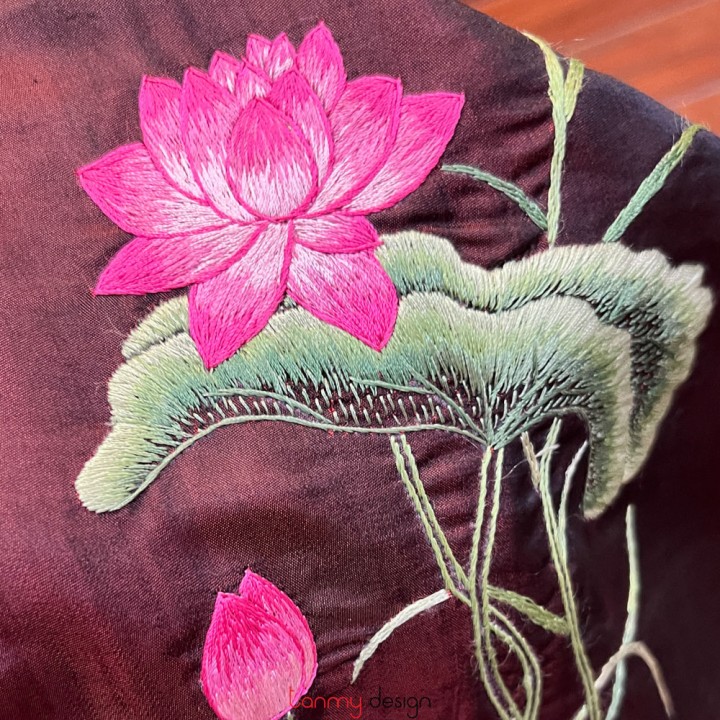
The lotus flower is among the most recognizable motifs associated with Vietnamese art. In Buddhist artistic traditions, it is linked to purity and spiritual awakening. On a contemporary silk scarf, a lotus design may evoke these associations while also serving as an elegant floral pattern. This makes it a thoughtful option for an international recipient, particularly when its cultural background is explained without suggesting that every lotus design carries a religious meaning.
Motifs inspired by Đông Sơn bronze drums offer another connection to Vietnamese heritage. The Vietnam National Museum of History documents imagery including central sun-like figures, birds, deer, dancers, and agricultural activities. These reflect aspects of ancient community life and ceremonial culture, although their precise symbolic meanings remain open to scholarly interpretation.
Other traditional motifs, including chrysanthemums, dragons, and phoenixes, appear in Vietnamese medieval decorative arts, including Buddhist and courtly contexts. Their significance should likewise be understood within specific artistic traditions.
Importantly, a modern scarf featuring a historical motif does not automatically preserve its original ceremonial or spiritual meaning.
For meaningful gifting, choose a motif with a traceable cultural reference and a design that suits the recipient. A clearly explained artistic inspiration offers a more authentic story than an unsupported promise of luck, protection, or prosperity.
What Does a Lotus Motif Mean on a Vietnamese Silk Scarf, and Is It a Suitable Gift for International Recipients?
A lotus motif on a Vietnamese silk scarf represents a longstanding connection to Vietnamese art and cultural heritage, often evoking purity, grace, and resilience. It can be a meaningful gift for an international recipient when the design suits their personal taste and the occasion.
The lotus has appeared in Vietnamese decorative arts for centuries, from ceramics and architectural carvings to religious sculpture. According to the Vietnam National Museum of History, its artistic representations evolved across successive dynasties, reflecting both cultural continuity and creative interpretation.
In Buddhist art, the lotus is associated with purity and enlightenment. However, a lotus design does not necessarily convey a religious message. On a silk scarf, it may simply celebrate the elegance of Vietnamese floral artistry and traditional motifs.
For international gift-giving, the recipient matters as much as the symbolism. A lotus-patterned scarf may be particularly thoughtful for someone who appreciates Vietnamese culture, textile art, or distinctive fashion accessories.
It is not automatically suitable for every recipient. Personal style, preferred colors, cultural sensitivities, and corporate gift policies may influence its appropriateness.
For a refined, meaningful gift, consider a subtle lotus design in colors the recipient enjoys, accompanied by a short note:
“The lotus has long been celebrated in Vietnamese art as an expression of grace and resilience. May this scarf bring you a beautiful reminder of Vietnam.”
How Do You Choose the Right Vietnamese Silk Scarf Motif for a Meaningful Gift?
Choose a Vietnamese silk scarf motif that reflects the recipient’s personal style, suits the gifting occasion, and carries a cultural meaning you can explain confidently. The most meaningful choice balances visual elegance, cultural significance, and everyday wearability.
Traditional Vietnamese-inspired motifs, including lotus flowers, birds, and landscapes, can turn a silk scarf into a thoughtful keepsake. However, cultural symbolism alone does not guarantee that a recipient will appreciate or wear it.
| Gift consideration | Recommended motif direction | What to check |
|---|---|---|
| Recipient’s preferences | Florals, birds, or landscapes | Favourite colours and personal style |
| Gifting occasion | Delicate florals for personal gifts; understated geometric patterns for professional occasions | Relationship and formality |
| Aesthetic appeal | Balanced compositions and harmonious colours | Compatibility with existing clothing |
| Cultural meaning | Lotus or identifiable Vietnamese landscapes | Verified symbolism and cultural context |
| Practical use | Versatile patterns with restrained colour contrasts | Styling options and care requirements |
For example, a lotus-motif silk scarf may be a thoughtful gift for an international recipient interested in Vietnamese culture, particularly when accompanied by an accurate explanation of its symbolism.
Gift-giving research highlights the importance of both emotional significance and recipient preferences.
These recommendations are conditional, not universal: an intricately patterned scarf may be less appropriate for someone who rarely wears accessories or prefers minimalist designs.
Ultimately, choose a motif the recipient will enjoy wearing, not simply one with an attractive cultural story.
How Can You Check a Silk Scarf's Motif, Material, and Craftsmanship Before Buying?
Before buying a Vietnamese silk scarf, examine its motif, fabric composition, printing or embroidery, and finishing details. A meaningful design deserves the same scrutiny as its material quality, especially when the scarf is intended as a special gift.
Use this checklist to assess both craftsmanship and cultural character:
- Motif and cultural inspiration: Identify the featured design, such as a lotus flower, and ask about its artistic inspiration. Look for a specific design story rather than a generic claim of Vietnamese heritage.
- Fabric composition: Check the exact fibre percentages. A label reading “silk” or “premium silk” does not necessarily establish 100% mulberry silk. Ask about fabric type and momme weight, where available.
- Printing or embroidery: Examine close-up photographs of both sides. For printed scarves, compare colour coverage and pattern definition. For embroidered pieces, inspect stitch consistency and the reverse side.
- Size and finishing: Confirm the dimensions, examine the edges and corners, and check for loose threads or uneven stitching.
- Care and provenance: Request product-specific cleaning instructions, manufacturer information, and any documented design history.
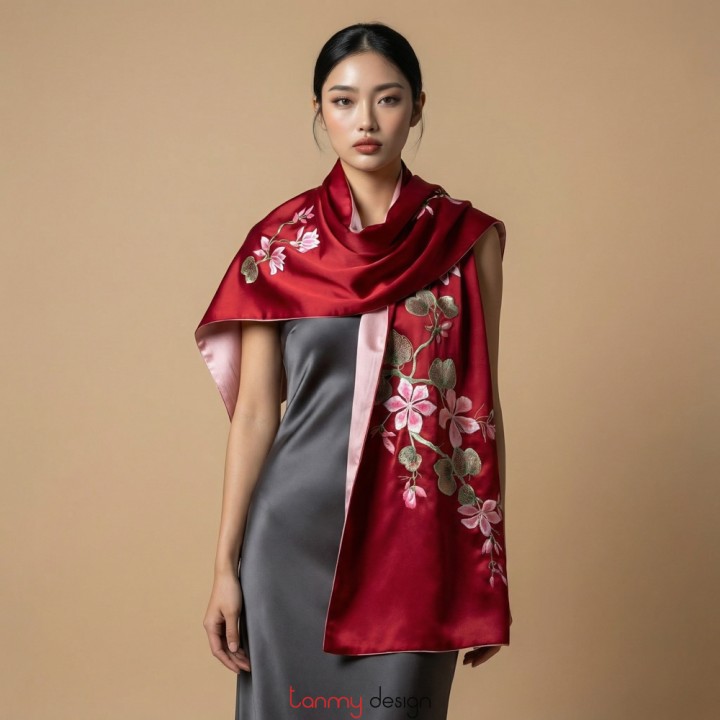
For example, Tanmy Design lists a 65 × 150 cm lotus-patterned scarf and a 25 × 200 cm lotus-embroidered scarf. These demonstrate distinct decorative approaches, but their listings do not establish every material or production detail.
If fibre percentages, production techniques, or origins remain unclear, request clarification before purchasing. A compelling cultural story should complement verifiable craftsmanship, not replace it.
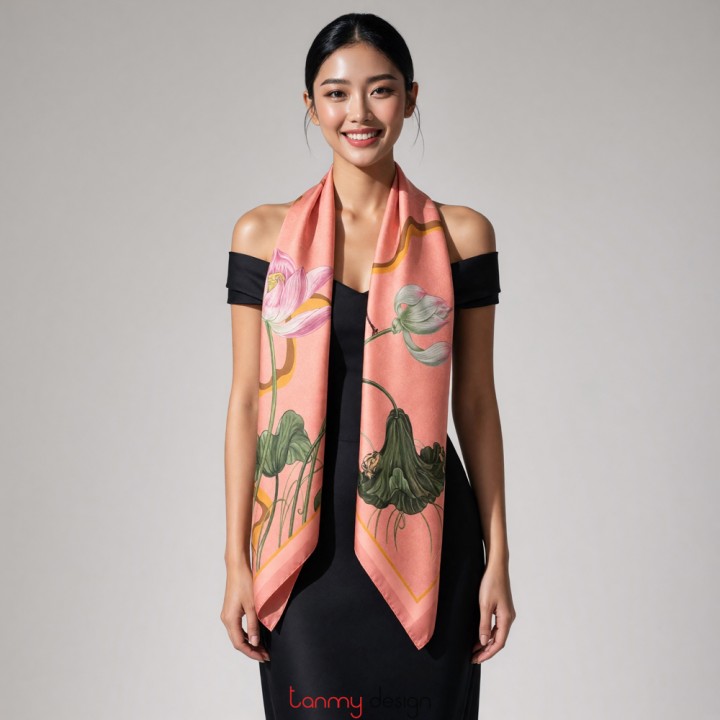
For an international recipient, a lotus-inspired silk scarf can be an elegant choice, while Đông Sơn imagery or heritage-inspired designs may appeal to someone interested in Vietnamese history and art. Choose a motif with a traceable cultural reference, and check how it has been adapted and produced before purchasing. When exploring Vietnamese-inspired gifts at Tân Mỹ Design in Hanoi, look for a scarf whose design story is as considered as its appearance.
Other articles
Square vs Long Silk Scarf: Which Makes a Better Gift?
Hand-Embroidered vs Printed Silk Scarves: Which to Gift?
_cr_720x720_cr_336x264.jpg)
Meaningful Personalized Gifts: What Makes Them Feel Truly Special
Thoughtful Gifts That Feel Personal Without Being Too Personal



Add: 61 Hang Gai St., Hoan Kiem Dist., Hanoi, Vietnam
Hotline: +84 936631368
Email: info@tanmydesign.com