
.png)
Night Robe for Women: Silk, Linen, or Embroidered Luxury?
Choosing a night robe for women as a gift can feel deceptively simple - until it needs to carry taste, story, and quiet prestige in a single piece. While cotton still accounts for about 49% of material usage, it is silk and finely crafted textiles that define the premium tier and shape how a gift is truly perceived. This guide helps you navigate silk, linen, and embroidery with the confidence to select something that feels not just beautiful, but worthy of the moment.
Which type of night robe are you actually choosing?
-
Choose a sleep-layer robe, if your priority is breathability, thermal regulation, and natural fibers like cotton - typically in the $20–$50 range, where most buyers stay, though 59% accept higher prices for eco-friendly materials (Cotton Incorporated, 2025; Cognitive Market Research, 2024).
-
Choose a loungewear piece for hosting or hybrid work, if you need a silhouette that looks presentable yet feels relaxed - often priced from $50–$100+, reflecting demand for garments that replace separate daytime outfits (Euromonitor, Statista, 2026; City Tech OpenLab, 2024).
-
Choose a premium gift-grade design, if the goal is emotional impact and prestige - buyers in this segment typically accept $100–$150+ for exclusivity, plush materials, or personalization like monogramming (Euromonitor International, 2025; NYT Wirecutter, 2024).
-
Choose a hybrid luxury style, if you want one night robe for women that works across all contexts - sleep, casual outings, and gifting - mirroring a 2026 shift where top 5% of premium products generate over 43% of category revenue by solving multiple needs at once.
Silk, linen, or embroidered: what’s the real difference?
When should you choose a silk night robe?
Choose a silk night robe for women when the goal is to impress with a refined, high-sensory gift that feels cool, elegant, and unmistakably premium - especially in warm climates or occasions where presentation and experience matter most.
Silk’s natural protein fibers create microscopic air pockets that release excess heat and regulate temperature, with a 2025 study cited by The Spruce showing cooling effects of 1–2°F under ideal conditions. In a Taihusnow user test (2025), 78% felt cooler and 65% noticed less moisture, which explains why it feels immediately “different” the moment it touches the skin.
That subtle sheen and frictionless texture are not decorative details - they are what signal luxury in gifting contexts. It’s the kind of piece that doesn’t need explanation; the material itself does the talking.
Still, this choice fits best when the recipient is comfortable with care-intensive fabrics. Silk requires hand-washing, pH-neutral soap, and air-drying, and typically lasts 3 to 7 years under normal use due to sensitivity to abrasion and UV exposure.
If the moment calls for elegance over convenience, silk is the clear answer.
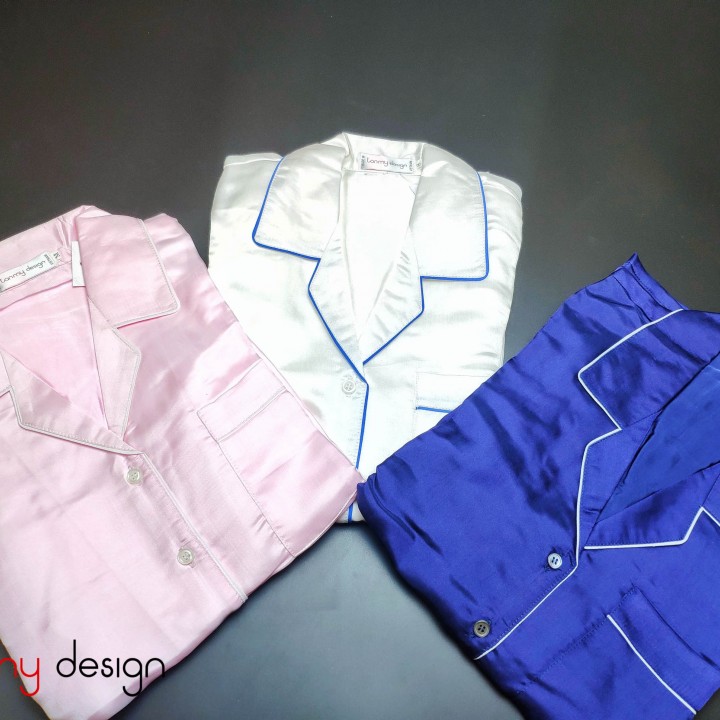
When is linen the better choice?
Linen is the better choice for a night robe for women when the priority is staying cool and dry in warm, humid conditions, where its fiber structure actively dissipates heat and accelerates moisture evaporation.
In controlled testing by the European Apparel Research Group (2022), plain-woven linen delivered 18% higher air permeability and evaporated sweat 23% faster than comparable cotton. At 32°C with high humidity, wearers reported feeling cooler 83% of the time, while cotton stayed damp 40% longer - a difference you can actually feel within minutes.
That comfort comes from flax fiber’s hollow core and pectin-rich walls, which drive rapid capillary action and evaporation. It can absorb up to 20% of its weight in moisture before feeling wet, pulling heat away efficiently with a thermal conductivity of 0.12 W/m·K (vs. cotton’s 0.07). The result: a robe that feels dry, breathable, and quietly reliable through long, warm nights.
There is a trade-off, though. This same structure makes the fabric prone to wrinkling, matte in appearance, and less fluid than silk, so it fits moments where ease and climate comfort matter more than polished shine or drape.
What does “embroidered luxury” actually add?
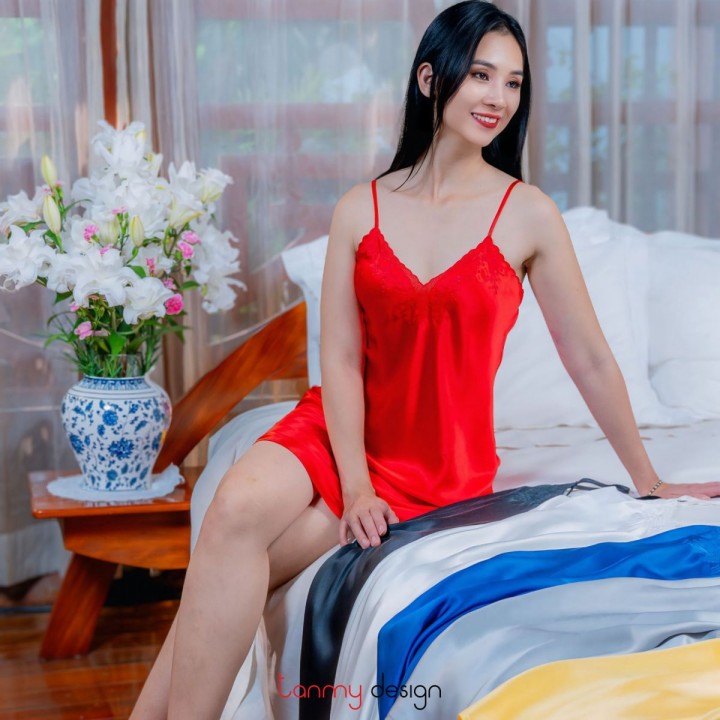
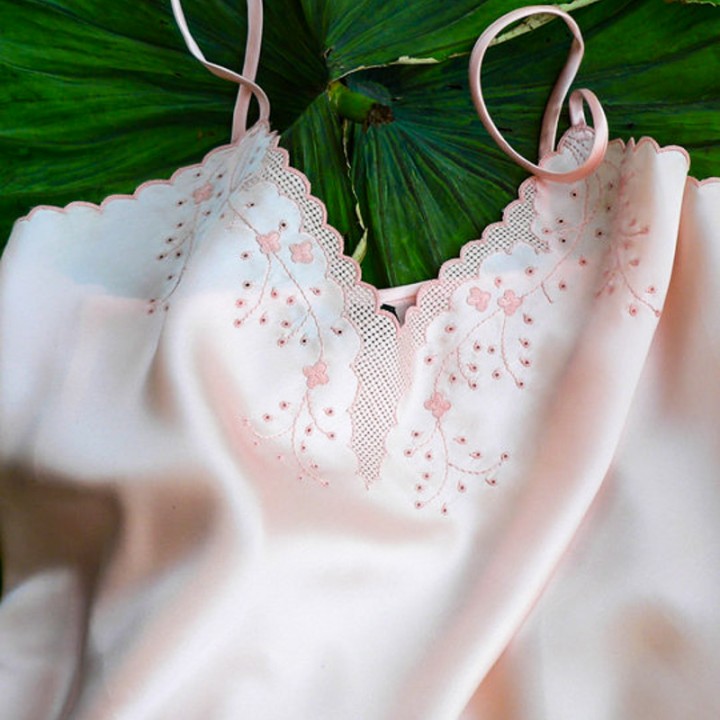
Embroidered luxury adds measurable value by increasing perceived authenticity, exclusivity, and emotional worth - raising willingness to pay by up to 17% for handcrafted details in a night robe for women.
That premium comes from something subtle but powerful: human touch you can actually feel. Hand embroidery creates a soft, slightly raised surface with natural variation - no two pieces are identical. This tactile depth signals time, care, and individuality, which buyers consistently associate with higher value.
Research cited by Maryadha (2026) shows handcrafted items are perceived as “imbued with love,” while the Fashion Revolution Report (2022) found 81% of consumers will pay more when artisan communities are involved. That connection - between maker and wearer - quietly elevates the garment beyond fabric.
But this effect disappears fast when embroidery is machine-made without story. Flat, uniform stitching - often backed for rigidity - reads as decorative branding, not craftsmanship. Without traceable origin or cultural context, it’s treated like expensive mass production.
So the difference isn’t just visual. It’s whether the piece carries evidence of human time and meaning - or just thread on cloth.
How do you evaluate if a robe is truly premium?
-
Check fabric density, not just feel: A premium night robe for women in silk should sit within 19–25 momme, as outlined by Lilysilk and Perlesilk (2023); below that, the fabric becomes fragile and loses long-term durability.
-
Measure moisture performance for cotton: According to Shop Lotus Linen (2026), high-grade cotton robes absorb 300%–350% of their weight in water, compared to standard levels of 200%–250%, directly affecting comfort and drying speed.
-
Inspect stitch density precisely: A construction benchmark from Altay et al. (JTEFT, 2024) shows 6 stitches/cm with lock stitching delivers seam strength exceeding 200 Newtons, reducing the risk of tearing under daily use.
-
Verify seam strength at stress points: ASTM-based apparel protocols (2025) require seams to withstand 15–25 lbs, especially around belts or pockets where failure typically begins.
-
Rely on tested metrics, not appearance: Fabric density is validated using GSM cutters and precision scales, while seam durability is tested with tensile machines simulating real stress - far more reliable than visual inspection alone.
-
Avoid common marketing traps: Labels like “100% cotton” may hide short-staple fibers, and visual images never reveal internal seam finishing or temporary coatings that wash out after first use.
What is the economic difference between cheap vs premium robes?
A night robe for women becomes economically better only when higher price translates into longer lifespan and frequent use; otherwise, cheap options often win on cost.
Pros of premium robes
When durability is real, the math shifts quickly. Alibaba’s 2026 sleepwear guide shows a ~$25 better-quality piece lasting ~2 years versus ~$12 items lasting ~6 months - about $25 vs ~$48 over 24 months with far fewer replacements. That’s a clear drop in replacement frequency and cumulative spend.
There’s also a usage effect: Technavio (2025) notes buyers prioritize comfort, skin feel, and wash durability - qualities that increase wear frequency. The more often it’s worn, the lower the cost per use, similar to apparel comparisons where longer lifespan (5–10+ years vs 1–3 years) reduces replacement rates by ~2x to 10x.
Cons of premium robes
The premium breaks down when price reflects branding or care complexity instead of durability. WRAP (2024) highlights that price doesn’t reliably predict lifespan in real use.
Low usage is the silent killer too - an expensive piece worn occasionally quickly becomes high cost-per-wear. Even sustainability premiums average around 9.7% (PwC, 2024), so overspending beyond that rarely returns proportional value.
Reality: premium pays when worn often and built to last; otherwise, it’s just a nicer receipt.
What are the biggest risks when choosing a night robe?
-
Expect a high chance of mismatch between expectation and reality, especially for a night robe for women bought online, where fit and style alone drive 53% of returns within a 24.4% return rate (Netpeak 2025).
Size charts vary by brand, so buyers often “bracket” multiple options - then end up disappointed when the silhouette or drape feels off in real life. -
Face hidden material substitution risks that visuals can’t reveal.
Textile verification by WAMA Underwear shows over 80% of fabrics are mislabeled, meaning what’s marketed as silk or premium fiber may actually be blended or synthetic - leading to pilling and loss of softness over time (SinoFineTex 2026). -
Miss the tactile truth - how the fabric actually feels and behaves in your climate.
The National Institutes of Health classifies sleepwear as a “tactile experiential product,” where comfort depends on touch, weight, and thermal response - things screens simply can’t convey. -
Underestimate how visual cues fail across all three risks.
2D images cannot show true drape, fiber authenticity, or breathability, which explains why preference-based issues account for up to 70% of fashion returns (Envive AI 2025).
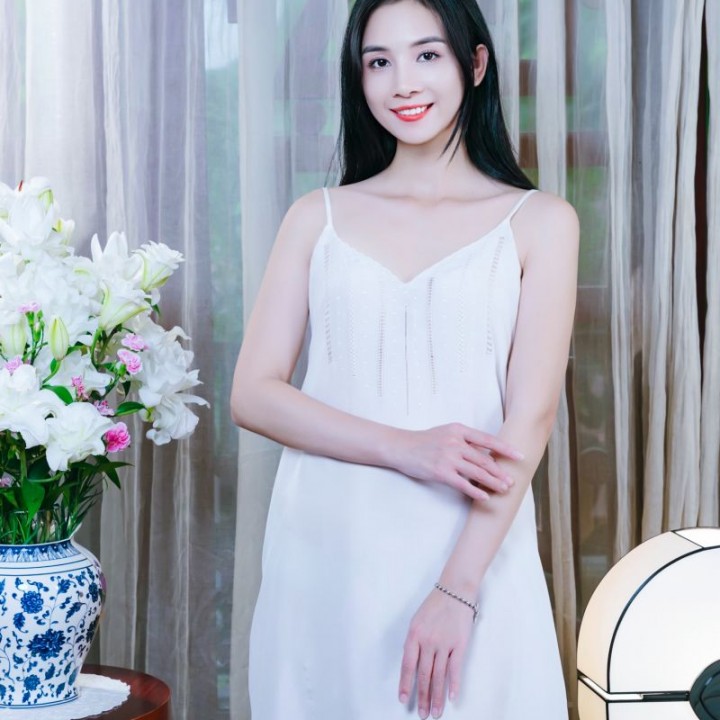
How do you choose the right one quickly?
-
Match silk when gifting priority is visual luxury. Silk stands out for its glossy texture and elegant drape, so it signals premium value fast - but expect high maintenance care, which can be a mismatch for recipients needing practicality.
-
Pick linen when daily usability matters more than impression. Linen works as breathable, versatile wear that transitions from sleep to lounging easily, yet its natural wrinkles can disappoint someone expecting a polished look.
-
Choose embroidered styles when emotional impact is the goal. Embroidery turns a standard night robe for women into a more thoughtful, story-rich gift, though its practicality depends on the underlying fabric.
-
Avoid defaulting to silk without checking lifestyle fit. A luxury-first shortcut often fails if the recipient prefers low-maintenance clothing, since silk commonly requires delicate care or dry cleaning.
-
Balance three signals: look, use, and care. Buyers typically decide fastest by weighing luxury impression vs. versatility vs. care effort, rather than overanalyzing features - this aligns with how sleepwear is evaluated in practice.
Source-aligned insight: material choice is usually a quick trade-off between visual appeal and daily usability, not a fixed “best option.”
A refined night robe for women is never just about comfort; it reflects how thoughtfully a gift is chosen and how it will be remembered. When material and craftsmanship align, the piece speaks on your behalf - subtly, yet unmistakably. At Tân Mỹ Design - Hanoi's premium cultural gift destination, each robe carries that sense of cultural depth and careful making. If the occasion calls for something meaningful, this is where your search can begin with clarity.
Other articles
Vietnamese Silk Scarf Motifs: Meanings & Gift Choices
Square vs Long Silk Scarf: Which Makes a Better Gift?
Hand-Embroidered vs Printed Silk Scarves: Which to Gift?
_cr_720x720_cr_336x264.jpg)
Meaningful Personalized Gifts: What Makes Them Feel Truly Special



Add: 61 Hang Gai St., Hoan Kiem Dist., Hanoi, Vietnam
Hotline: +84 936631368
Email: info@tanmydesign.com