
.png)
Table Cloth Embroidery vs Machine Stitch: What Truly Matters
In Hanoi’s Old Quarter, beauty whispers through every stitch and story. For those seeking table cloth embroidery that honors heritage, the best handmade clothing stores here aren’t just shops - they are living ateliers of Vietnamese craftsmanship. Whether you're a cultural traveler or a collector of handmade goods, these spaces offer more than fabric; they offer a connection to time, artistry, and meaning.
What Is Table Cloth Embroidery?
Table cloth embroidery is the intricate, hand-stitched decoration of linen, cotton, or silk table coverings using heritage Vietnamese techniques passed down through generations.
This traditional art form dates back over 700 years and reflects Vietnam's rich cultural identity. Originating in villages like Quat Dong and Van Lam, it became a living archive of royal aesthetics and national symbolism. Motifs such as lotus flowers and the Four Noble Trees are embroidered with layered stitching to mimic painted textures.
Fabric and thread selection play a vital role - Vietnamese silk and fine cottons enhance the realism and durability of each design. Artisans favor soft tones and precision stitches like satin, split, and long-and-short, applied through a meticulous process involving pattern transfer, hand embroidery, inspection, and packaging.
More than decoration, each tablecloth is a labor-intensive artwork that encodes time, skill, and cultural memory - making it a cherished, meaningful gift for those who value elegance and authenticity.
How Machine Stitch Embroidery Works
Machine stitch embroidery works by following pre-programmed digital coordinates that guide a needle to lock threads together at high speed, creating precise and durable textile patterns.
This process uses a lockstitch mechanism, which interlocks two threads - upper and bobbin - within the fabric, ensuring a tight, flat finish suitable for efficient, large-scale production. However, this technical precision erases the dimensionality and subtle human variations found in hand-stitched embroidery.
Three core factors shape the visual difference:
-
Thread tension: Machines keep threads taut to avoid errors, which reduces luster and softness.
-
Pattern repetition: Motorized pantographs create exact geometric patterns, producing a rigid, grid-like surface.
-
Stitch path automation: Software optimizes for speed, not artistic flow, limiting the nuanced direction changes seen in handcrafted textiles.
While machine-made table cloth embroidery ensures consistency and speed, it lacks the organic "hand" - the micro-irregularities, texture, and storytelling - that imbue traditional Vietnamese embroidery with soul.
The Essence of Hand-Embroidered Tablecloths
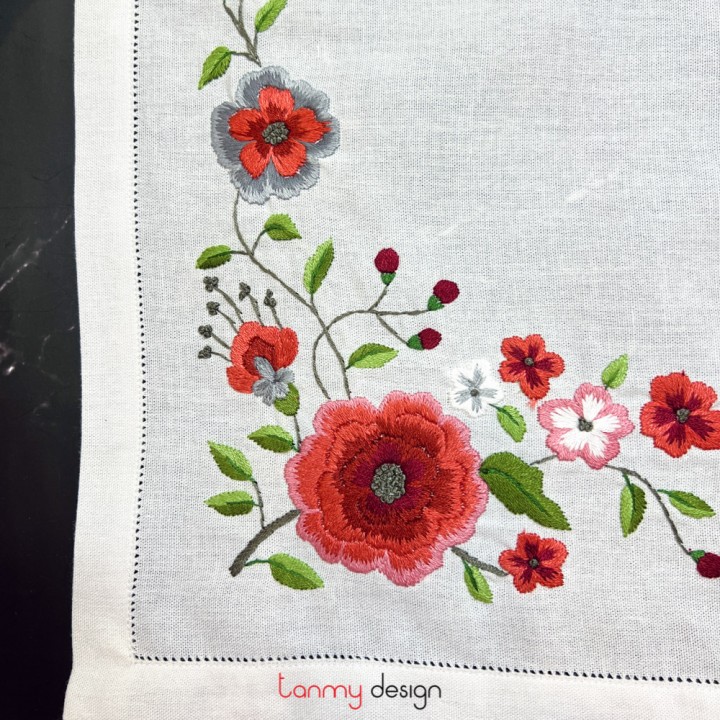
True table cloth embroidery reveals itself through imperfection - subtle irregularities in stitch length, angle, and density are hallmarks of hand-guided craft.
Rather than the mechanical regularity of digitized patterns, authentic handwork carries human variation in needle path and layering. You’ll often see shifts in stitch direction to match curves or shading, and a reverse side that shows scattered, non-repeating thread paths - not the tidy grids left by machines.
Look for signs like inconsistent spacing in border corners, nuanced overlaps in dense motifs, or changes in flow across curves. Stitch density is rarely uniform in genuine pieces, and areas of “too perfect” symmetry often flag automated fills.
Quantitative validation matters, too. Sampling macro photos to measure variation in stitch length and angle across different zones provides defensible authenticity markers. Additionally, objective tests of fabric softness and stiffness (e.g. KES or ASTM D1388) can confirm material quality consistent with high-skill labor.
Finally, time claims must match stitch complexity. A large tablecloth with a modest border can involve upwards of 17,500 hand-placed stitches, often requiring 100+ hours of labor. Without documentation - like progress photos, timestamped logs, or maker notes - such claims risk sounding ornamental rather than evidential.
If you're seeking a timeless, meaningful gift or collectible, trace the human hand behind every thread. It’s not flawlessness but living texture that defines true embroidery.
Why Authentic Hand Embroidery Matters
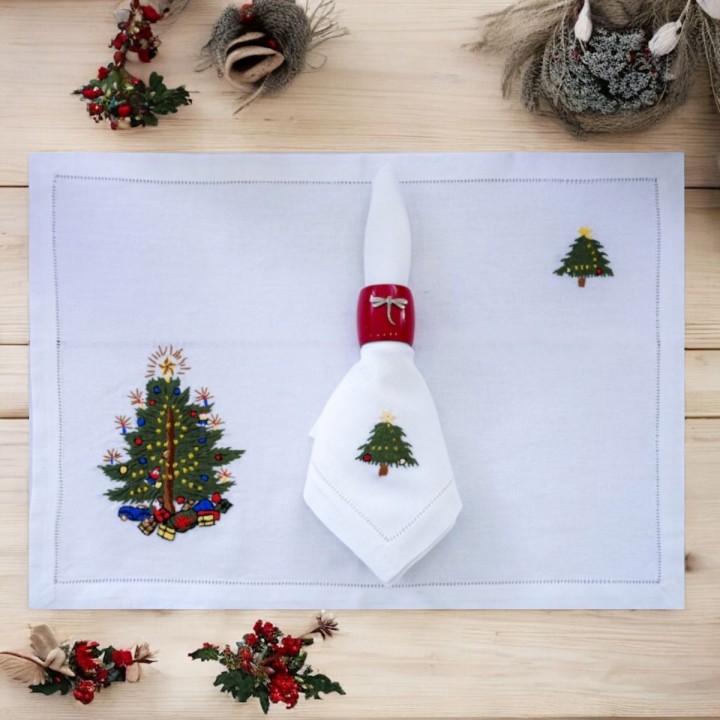
Authentic table cloth embroidery matters because it embodies cultural heritage, artisanal patience, and emotional value that machine-made items cannot replicate.
Each hand-stitched piece becomes a visual narrative - blending silk and thread into photorealistic gradients using techniques like the “long and short stitch.” Unlike surface-level machine embroidery, these stitches are structurally integrated, producing a fluid texture and preventing wear over time.
This craft has adorned diplomatic tables, gifted by leaders like Bill Clinton, and stands as a symbol of national pride. Its value is not just visual - provenance, artisan lineage, and heirloom durability elevate it into a luxury asset, not a disposable souvenir.
A gift woven with human hands carries soul (hồn), patience (kiên nhẫn), and a story. Isn’t that what makes a gift truly unforgettable?
When to Choose Hand-Embroidered vs Machine-Made
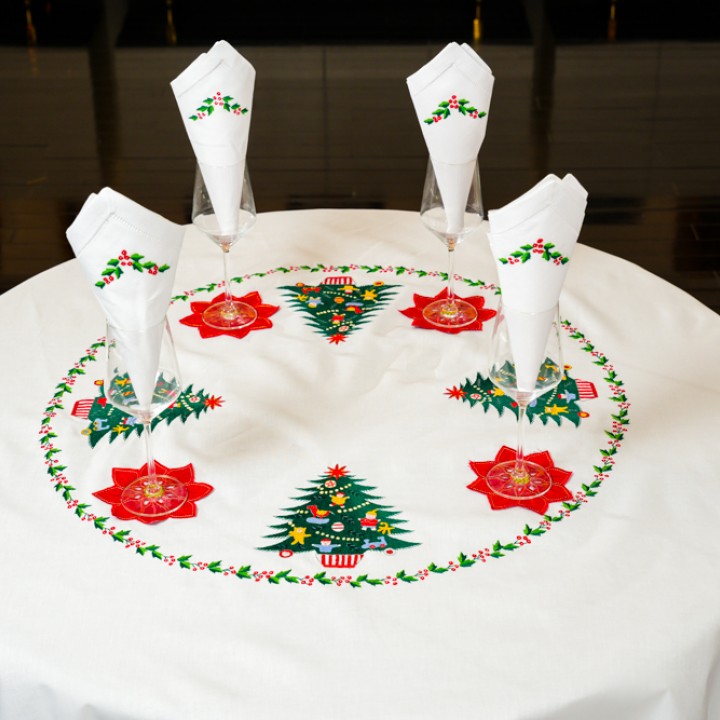
Choose hand-embroidered tablecloths when emotional resonance, artisanal prestige, and cultural storytelling matter more than cost-efficiency or maintenance ease.
Hand-stitched pieces are ideal for meaningful gifting, heirlooms, or enhancing intimate spaces with texture and soul. Each design reflects human touch - often requiring 40+ hours of labor - and carries regional identity from Vietnamese embroidery villages like Quat Dong or Da Lat. These are not just linens; they’re legacies meant to be passed down.
By contrast, machine-made embroidery suits short-term needs where logistics, visual uniformity, and cost-per-use take priority. For example, a 20-table wedding reception benefits from rentals priced at $7–$15 per unit, offering ease without compromising aesthetics. These versions are durable, withstand industrial laundering, and offer visual precision for high-volume settings.
A simple rule: if you're choosing a gift with meaning, or a piece to live with, hand embroidery offers warmth, intention, and heritage. If you’re managing a large event or prioritizing utility, machine-made options are the practical and polished solution.
_cr_720x720.jpg)
How to Care for Hand-Embroidered Tablecloths
To care for table cloth embroidery, wash only in cold water (below 30°C), using a neutral pH detergent without enzymes, and air dry flat to avoid damaging threads.
Silk and cotton embroidery threads are highly sensitive to heat, alkalinity, and agitation. Hot water accelerates dye bleeding and causes base fabrics to shrink unevenly, distorting patterns. Enzyme detergents degrade silk proteins, making threads brittle. Tumble drying leads to fiber breakage, fraying, and visible fuzz that dulls color vibrancy.
For heirloom quality preservation, this low-stress care routine maintains colorfastness (Gray Scale ≥ 4) and fiber integrity (Pilling Grade ≥ 4) even after 50+ washes.
Where to Find Genuine Vietnamese Hand Embroidery
For authentic table cloth embroidery in Hanoi’s Old Quarter, Tân Mỹ Design at 61 Hàng Gai offers a rare blend of heritage, quality, and trust.
Set inside a renovated French villa, this 1,000-square-meter showroom feels more like a gallery than a store. With natural light casting shadows on fine silk threads, and time allowed to touch each stitch, visitors experience embroidery as a tactile art - far removed from the mass-produced alternatives found nearby.
Live demos and artisan-led workshops give immediate proof of authenticity. Seeing a petal take 20 minutes to complete justifies the price - and the pride. Meanwhile, stories of four generations, dating back to 1969, tie each linen piece to a living Vietnamese legacy.
If you’re seeking heirloom-quality craftsmanship, not tourist trinkets, this is where luxury and meaning align.
When you walk the winding lanes of Hanoi’s Old Quarter, you're not just shopping - you’re tracing generations of artistry through thread and touch. Every embroidered table cloth or garment carries a soul, patiently crafted by hands that remember. If you seek gifts that tell stories or décor that speaks of heritage, explore the curated elegance of Tân Mỹ Design. Discover the legacy at tanmydesign.com - where refinement meets tradition.
Other articles
Vietnamese Silk Scarf Motifs: Meanings & Gift Choices
Square vs Long Silk Scarf: Which Makes a Better Gift?
Hand-Embroidered vs Printed Silk Scarves: Which to Gift?
_cr_720x720_cr_336x264.jpg)
Meaningful Personalized Gifts: What Makes Them Feel Truly Special



Add: 61 Hang Gai St., Hoan Kiem Dist., Hanoi, Vietnam
Hotline: +84 936631368
Email: info@tanmydesign.com