
.png)
Authentic Local Art in Hanoi: What to Buy & Where
Authentic local art in Hanoi is best judged by provenance, not by a “Vietnamese” or “handmade” label alone. From Bát Tràng ceramics and Vạn Phúc silk to lacquer, embroidery, silverwork, paintings, and handcrafted jewelry, the strongest pieces reveal who made them, where they were produced, which materials were used, and how the craft connects to a specific tradition. For meaningful or high-end gifting, those details help distinguish culturally traceable work from souvenirs that simply borrow a local aesthetic.
What Counts as Authentic Local Art in Hanoi?
Authentic local art in Hanoi is better judged by verifiable authorship, making process, materials, and provenance than by a “Made in Vietnam” label alone. Vietnam’s Ministry of Industry and Trade noted in December 2025 that the domestic market still lacked a unified legal criterion for determining when goods qualify as Vietnamese in origin, so a national-origin label does not by itself establish artistic or craft authenticity.
- Original fine art: Look for a named artist, signature, date, medium, gallery record, and where relevant edition number or ownership history. The defining evidence is individual authorship plus traceable provenance, not simply where the object was sold.
- Artisan handicrafts: A credible piece should connect to a named maker, workshop, or recognized craft tradition and explain how it was made. Hanoi officially recognizes traditional craft villages, providing a stronger geographic and cultural link than an anonymous souvenir label.
- Designer decorative objects: These may legitimately combine contemporary design with workshop production. Authenticity here means the designer or studio, collection, materials, and production relationship can be identified—even when the designer did not personally make every piece.
- Mass-produced souvenirs: Repeated identical stock, no identifiable maker, vague production details, and only a country-of-origin label provide much weaker evidence of local artistic authorship.
For a prestigious gift, the practical distinction is therefore traceability, not rustic appearance: ask who designed or made it, where and how it was produced, what materials were used, and what documentation supports that story. “Made in Hanoi,” “Made in Vietnam,” and “made by a Hanoi artist” answer different questions and should not be treated as interchangeable.
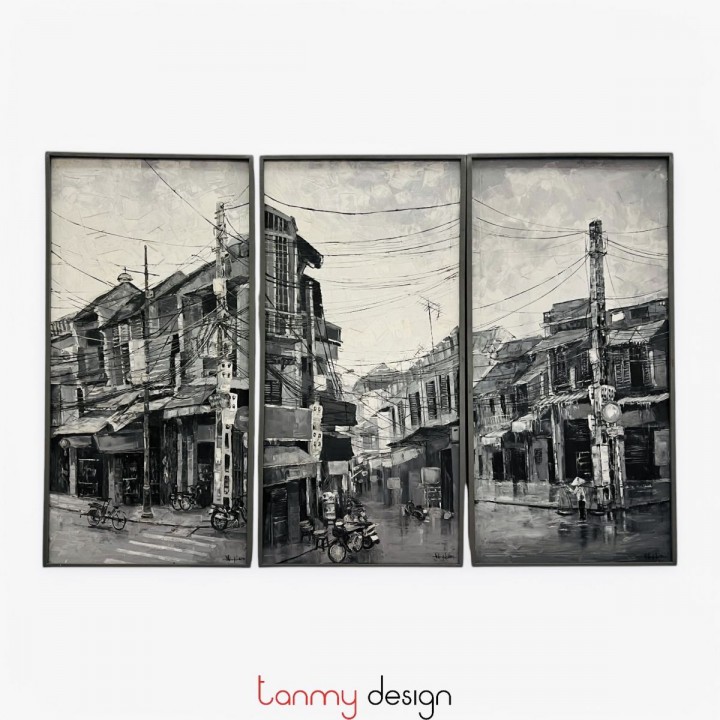
What Local Art Is Worth Buying in Hanoi?
The most worthwhile local art in Hanoi is not simply the piece that looks traditional, but one whose maker, technique, material, and place of production can be traced to the specific object. Public craft catalogues show a useful distinction: cultural storytelling at brand level is common, while product-level provenance is much less consistently documented.
| Local art | Why it is worth considering | Gift fit | What to verify before buying |
|---|---|---|---|
| Hand embroidery | Connects directly with traditions such as Quất Động embroidery; silk or linen pieces can combine skilled handwork with Vietnamese motifs. | Elegant, lightweight, easy to carry. | Hand vs. machine embroidery, thread composition, workshop or artisan origin. |
| Vietnamese lacquerware | Traditional lacquer can involve layered sơn ta, polishing, eggshell, mother-of-pearl or gold-leaf decoration. | Particularly suitable for formal or representative gifts. | Lacquer type, substrate, inlay materials, workshop, care instructions. |
| Dó paper & folk prints | Đông Hồ printing and handmade dó paper preserve identifiable materials, techniques and folk imagery. | Strong cultural meaning without excessive weight. | Genuine dó paper, printing method, pigments, artist or workshop. |
| Bát Tràng ceramics | Offers a clear connection to a documented Hanoi-area craft tradition through clay, glazing and hand decoration. | Strong choice for substantial home or corporate gifts. | Kiln/workshop origin, hand-painted elements, packaging and food safety where relevant. |
| Silver jewelry & design objects | Compact pieces can reference Hàng Bạc traditions and Vietnamese motifs. | Refined and highly portable. | Metal fineness, maker, warranty and production origin. |
The key buying rule is therefore provenance before appearance. Craft Link documentation, for example, can identify villages, materials and historical makers, yet still may not establish who made an individual item; broader retailer claims can be even less specific. A prestigious gift should therefore come with product-level answers not merely a convincing “traditional Vietnamese” story.
.4,465k_cr_720x720.jpg)
How to Tell Craftsmanship From a Generic Tourist Souvenir
Authentic local art in Hanoi is better judged by a combination of physical craft traces and a specific, verifiable production story not by a “handmade” label, luxury packaging, or price alone.
- Look for controlled variation, not careless flaws. Hand embroidery may show slight differences in stitch length; carved wood can retain fine tool marks; handmade ceramics may reveal wheel, finger, or wire-cut traces. Repeated motifs can vary subtly rather than appearing mechanically identical.
- Inspect what is normally hidden. Turn textiles over to examine thread ends and knots; check ceramic bases, basket joints, and lacquer edges. These less-visible areas often reveal the production method more clearly than the polished front.
- Compare identical pieces nearby. Public buyer accounts describe supposedly handmade lacquerware appearing in exactly the same designs across different shops, sometimes at sharply different prices. This does not prove an item is factory-made, but repeated identical stock is a reason to question claims of individual craftsmanship.
- Ask questions that require specific answers: Which village or workshop made this? What material is used? Which steps are done by hand? Vague answers such as “from a village” provide little authentication value.
- Treat price and presentation as secondary evidence. Expensive does not automatically mean handmade, just as minor irregularities alone do not prove authenticity. For a significant gift, the stronger standard is craft evidence + material evidence + traceable origin.
How to Choose Local Art for a Meaningful Vietnamese Gift
For a high-end Vietnamese gift, choose local art by what the recipient can confidently understand, display, and retell not simply by how “Vietnamese” it looks. The strongest gifts combine cultural meaning, traceable craftsmanship, refined presentation, and practical ownership.
- Start with a story worth retelling. Look for a work connected to a recognizable Vietnamese craft tradition, motif, technique, or cultural context. For partners or VIPs, the story should be explainable in a few sentences and appropriate to the relationship not merely decorative.
- Ask for provenance, not just a “handmade” label. A named artisan, workshop, craft village, technique, edition, or certificate gives the recipient evidence that the object is authentic rather than mass-produced. This distinction matters especially for expensive artwork or jewelry marketed as authentic local art.
- Judge the complete gift experience. Elegant boxing, a short card explaining the work, and discreet personalization can move the same object from souvenir territory into a representative gift. Large logos, by contrast, can make a personal cultural gift feel promotional.
- Check whether ownership will be effortless. Ceramics, framed art, lacquerware, sculpture, and other fragile pieces may require professional packing or special international shipping.
The practical rule is simple: buy the piece whose origin you can verify, meaning you can explain, and presentation and logistics you can manage confidently.
Where to Buy Authentic Local Art in Hanoi
For high-end gifting, the best place to buy authentic local art in Hanoi depends on what you need to verify: galleries are strongest for named authorship, maker-led workshops for technique and provenance, while specialist craft boutiques offer the most practical balance of authenticity evidence, presentation, and gift-ready service.
| Where to buy | Strongest evidence | Best for | What to verify before buying |
|---|---|---|---|
| Gallery | Artist name, signature, certificate of authenticity, artwork history | Original paintings or collectible lacquer works | Confirm the certificate, materials, dimensions, artist and specific work match |
| Maker-led store / workshop | Direct view of production, workshop identity, craft-village provenance | Traditional ceramics, weaving, lacquer and other technique-led crafts | Ask who made the item, where each stage was completed and which materials were used |
| Specialist craft boutique | Curated sourcing, material information, craft stories, refined packaging | Prestigious gifts for partners, VIPs and formal occasions | Check whether provenance and artisan information apply to the individual item—not merely the collection or store |
| Markets / Old Quarter shopping streets | Broad selection and flexible pricing | Convenient or lower-budget souvenirs | Authorship, materials and production origin usually require more independent checking |
The important distinction is that a reputable shop is evidence about the seller, not automatically about every object it stocks. Public reviews of stores such as Craft Link, Kilomet109 and An Handmade describe craft traditions and sourcing stories, but they do not independently establish the maker, fibre, dye or production method of every individual product.
For a meaningful premium gift, therefore, prioritize product-level provenance: maker or workshop, material disclosure, production origin and documentation. Store reputation should begin the verification process, not replace it.
Buying Vietnamese Craft at Tân Mỹ Design in Hanoi’s Old Quarter
Tân Mỹ Design is a strong place to shortlist a prestigious Vietnamese gift because it combines a documented embroidery lineage with several craft categories in one Old Quarter showroom but the heritage of the brand should not be mistaken for verified provenance of every individual piece.
Tân Mỹ traces its embroidery tradition to 1969 and four generations of Hanoi women, while the contemporary Tân Mỹ Design store at 61 Hàng Gai opened in 2009. Its three-level showroom brings together hand embroidery, silk, lacquerware, fashion, jewelry, accessories and art, allowing buyers to compare different forms of Vietnamese craft without moving between specialist shops. The company also records receiving Hanoi’s Standard Tourist Service certificate in 2017.
That combination matters for an important partner or VIP gift: the strongest trust signal is not simply that an object looks “traditional,” but that the retailer has a traceable craft history and offers enough categories to match the recipient and occasion. Yet this evidence has a limit. Tân Mỹ’s public materials substantiate its embroidery heritage and broad product range; they do not automatically establish the maker, workshop, material origin or provenance of each SKU.
For jewelry in particular, do not assume that a necklace is authentic jade simply because it is sold in the Old Quarter. The current jewelry page mentions pearls, gold, silver, diamonds and gemstones, but does not provide a blanket verification of jade. For a high-value purchase, ask for the specific material, origin, maker and any available certification for that exact piece.

What to Ask Before You Buy
Treat any piece of authentic local art in Hanoi as a small verification file, not simply a beautiful object: the strongest purchase is one whose maker, materials, technique, documentation, and aftercare tell the same consistent story.
- Who actually made or designed it? Ask for the artist, designer, craftsperson, or workshop by name and their specific role. “Handcrafted in Vietnam” is weaker evidence than a named maker, studio profile, signature, edition number, or documented collaboration.
- Where was it made? A Hanoi gallery address proves where an item is sold, not where it was produced. Distinguish the place of design, handwork, fabrication, assembly, and finishing.
- What exactly is it made from? Look beyond “natural,” “wood,” “silver,” or “lacquer.” Ask for the specific material, alloy, wood species, coating, stone, or finishing process.
- Which stages are genuinely handmade? Terms such as hand-carved, hand-painted, or woven by [named workshop] are more informative than “artisan-inspired” or “traditional craft.”
- What documentation comes with it? For important gifts, request an invoice, artist or workshop attribution, certificate where relevant, edition details, condition information, care instructions, and international-shipping terms.
- For jade or gemstone jewelry, is there an independent laboratory report? Seller descriptions, photographs, provenance stories, and even the claim “natural jade” do not scientifically establish authenticity. GIA notes that jade may be dyed, bleached, waxed, or polymer-impregnated, while its Report Check service lets buyers verify report data independently.
For a prestigious gift, missing information is not automatically proof of poor quality but it is a reason to verify rather than assume.
A Simple Way to Choose the Right Piece
For authentic local art in Hanoi, choose by the kind of value you want the gift to carry not by labels such as “handmade,” “traditional,” or “designer-made.” Those words become meaningful only when the maker, material, technique, and provenance can be verified.
- Choose original artwork when named authorship and collectability matter most. Look for the artist’s name, medium, dimensions, year, signature, exhibition history, and where appropriate a certificate of authenticity. Confirm that the piece is an original rather than a print or reproduction.
- Choose traditional artisan craft when cultural technique and connection to a Vietnamese craft community matter more than uniqueness. Ask who made it, where it was produced, which stages were handmade, and whether the stated material and technique genuinely come from the named village or community.
- Choose a refined design object when the recipient is likely to use or display the gift regularly. Prioritize a named designer or studio, clear material specifications, workmanship, practical dimensions, care information, and packaging suitable for presentation and travel.
- Choose a curated multi-category boutique when you need to compare artwork, textiles, lacquer, ceramics, jewelry, and design objects in one place. The convenience is valuable, but provenance should still be checked piece by piece, rather than inferred from the boutique’s reputation.
A useful rule: the more a price depends on authorship, rarity, or heritage, the more specific the provenance should be.
A worthy Hanoi gift should carry more than visual appeal: its maker, place of production, materials, technique, and cultural context should be clear enough to trace. That principle applies equally to ceramics, lacquer, textiles, paintings, silverwork, and jade jewelry, where a material name alone does not establish authenticity. Before choosing a representative gift, ask for the story and evidence behind the piece; at Tân Mỹ Design, that standard of cultural substance can guide a more considered selection.
Other articles

Vietnamese Silk Scarf Motifs: Meanings & Gift Choices
Square vs Long Silk Scarf: Which Makes a Better Gift?
Hand-Embroidered vs Printed Silk Scarves: Which to Gift?
_cr_720x720_cr_336x264.jpg)
Meaningful Personalized Gifts: What Makes Them Feel Truly Special



Add: 61 Hang Gai St., Hoan Kiem Dist., Hanoi, Vietnam
Hotline: +84 936631368
Email: info@tanmydesign.com