
.png)
5 Signs Your Embroidered Laundry Bag Is Truly Handmade
True handmade artistry isn’t loud - it’s in the quiet elegance of every stitch, every thread, every story. A genuine laundry bag embroidered by hand holds subtle clues: slight variations, intentional imperfections, and a cultural soul that no machine can mimic. When you know what to look for, you’ll recognize not just a product - but a piece of heritage worth treasuring.
1. Uneven Yet Beautiful Stitch Lines (Natural Imperfection)
A truly handmade laundry bag embroidered piece reveals itself through subtly irregular stitch lines that reflect natural human variation, not mechanical uniformity.
Machine-made stitches are exact, repetitive, and rigid - especially on unstable mesh, where machines compress fabric using high tension and stabilizers. In contrast, hand embroidery adapts dynamically: artisans adjust thread tension in real time, often wrapping around mesh threads instead of piercing them, leaving a gentler surface with no backing residue.
While machines generate perfect geometric patterns with identical spacing and stitch length (CV < 1%), handcrafted bags display slight fluctuations (CV > 5%) and organic rhythm. This natural "imperfection" - in motif placement, stitch flow, and thread texture - becomes a fingerprint of human touch, impossible to clone at scale.
Look for beauty in the slight irregularities - they’re not flaws, but proof of soul.
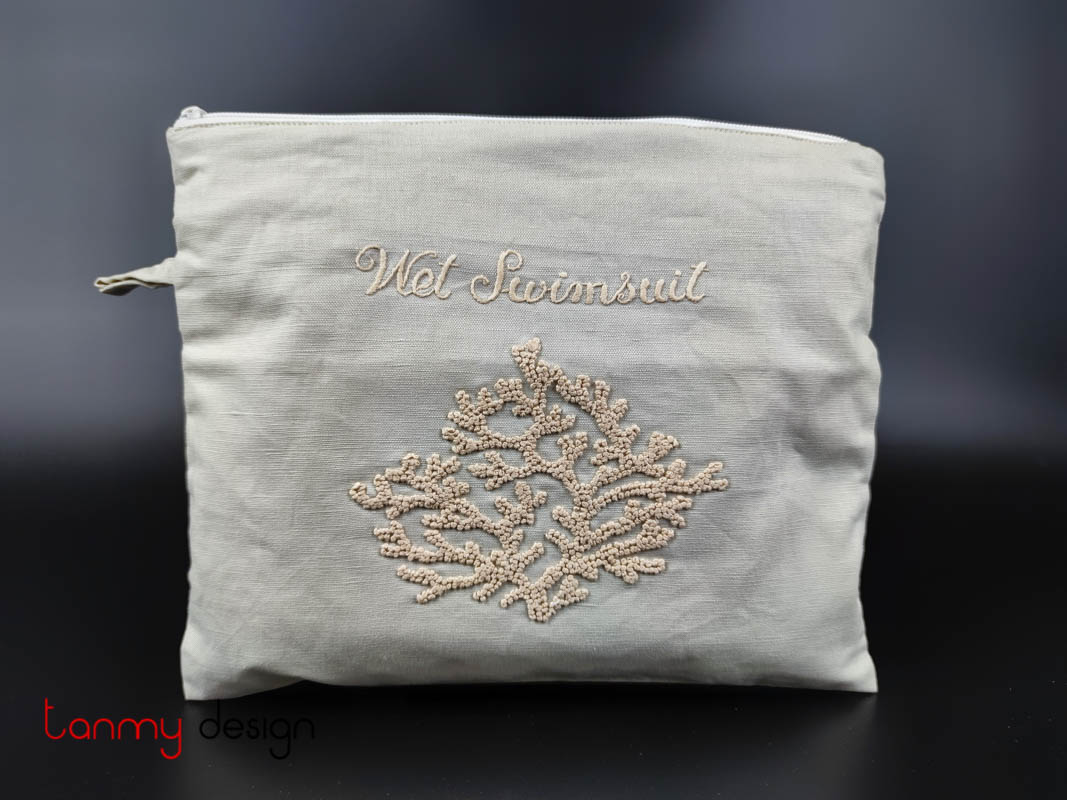
2. Unique Motifs and Color Shading (No Two Bags Alike)
No two handmade laundry bags share the exact same color gradients or motif shading because each piece is built on a technique machines cannot replicate.
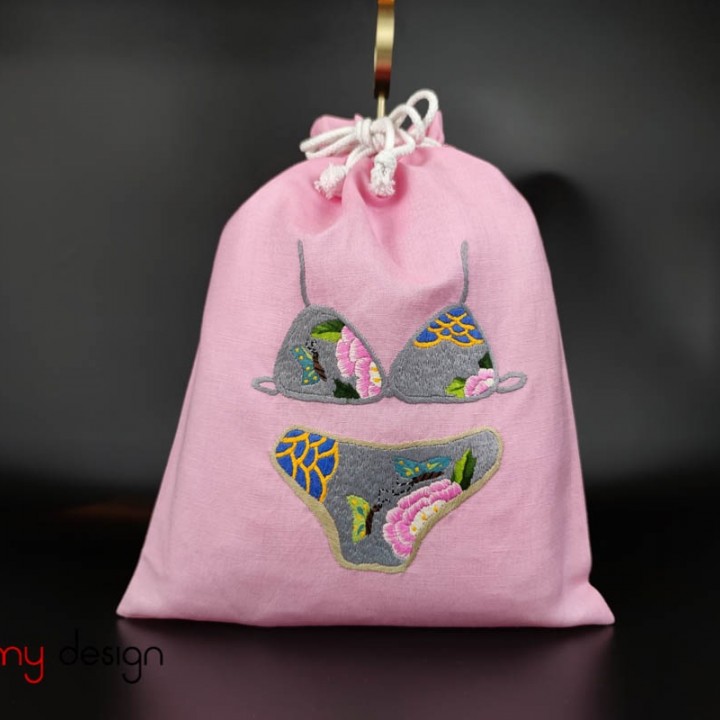
Artisans blend thread colors using the “long and short” stitch, piercing through previous threads to create smooth transitions - like brushstrokes - whereas machines rely on fixed-direction, pixel-like layers that form visible steps instead of seamless blends.
Skilled embroiderers also twist two threads of different hues or vary stitch angles to reflect light differently across the fabric. This produces optical mixing and subtle shifts in tone as the bag moves - an effect machines can’t mimic due to standardized stitch paths and limited thread counts.
If two bags look exactly the same, that’s your first red flag - it’s likely a cloned, machine-made copy.
3. Quality Fabric and Lining (Foundation of Longevity)
Linen ensures embroidery stays intact through years of washing, making it the superior fabric for a truly handmade embroidered laundry bag. Unlike silk, which weakens and stretches when wet, linen’s cellulose-based structure becomes 20% stronger, anchoring every stitch through wash cycles without distortion.
Its firm weave, low elasticity, and natural fiber density create ideal friction against embroidery threads. This prevents pull-through or sagging - common failures in lower-quality fabrics.
While silk may look refined, its smooth texture and high elasticity make it prone to stitch migration unless heavily stabilized. That aesthetic comes at the cost of structural reliability.
For collectors and connoisseurs, linen signals craftsmanship that endures. Touch the inside - if the lining and outer fabric feel dense, stable, and tightly woven, you’re holding more than just laundry storage. You’re holding textile integrity.
_cr_720x720.png)
4. Signature, Tag, or Artisan Mark (Proof of Origin)
A signature, tag, or artisan mark on an embroidered laundry bag is a key proof that it’s truly handmade. These details serve as trust indicators that connect the piece to a real person, place, or tradition - something mass-produced items cannot replicate.
Unlike printed labels, a stitched signature is often subtly woven into the design and acts like a personal seal, proving the artisan held and worked on the item. For villages like Van Lam or Quat Dong, workshop tags are more than branding - they’re a form of cultural certification, protecting regional heritage and ensuring origin authenticity.
To prevent fraud, Vietnam’s OCOP program and Geographical Indication (GI) tags help validate the product's origin and quality standards. These safeguards matter: in the textile world, up to 50% of "Vietnamese silk" can be falsely labeled without such controls.
When you see an artisan’s mark or a woven tag on your laundry bag, you’re not just buying a product - you’re preserving a legacy.
5. Signs Your Embroidered Laundry Bag Is Truly Handmade
Without provenance, even the finest laundry bag embroidered by hand risks being mistaken for a factory-made fake.
Mass-market products use vague phrases like “hand-finished” and “premium thread,” but true handmade pieces carry verifiable stories - narratives that root each stitch in heritage, struggle, and identity.
Cultural storytelling transforms a simple bag into a vessel of meaning. When your item names its maker, traces the thread to a specific Vietnamese village, and shows signs of human effort - like imperfect stitches or visible knots - it taps into the psychology of “positive contagion,” letting buyers feel they own a piece of the artisan’s soul.
This emotional connection builds trust and elevates value. Provenance is more than romance; it’s proof - of time, hands, and history.
How to Care for Your Hand-Embroidered Laundry Bag
To preserve the integrity of your Embroidered Laundry Bag, care must honor its delicate construction and cultural value.
1. Always hand wash in cold water. This minimizes shear force, preventing thread slippage and fuzzing. Natural fibers swell when wet, weakening bonds that hold embroidery in place—machine washing risks permanent distortion.
2. Use pH-neutral, non-enzymatic detergent. Avoid bleach or optical brighteners, which can degrade both cellulose-based fabrics and protein-based threads like silk.
3. Never wring or twist. Excess handling strains the fiber alignment. Instead, press between clean towels to remove moisture gently.
4. Dry flat in shade. UV exposure accelerates photo-oxidative decay, leading to brittle fibers and faded dyes. Hanging while wet can stretch the fabric unevenly, causing warping or puckering where embroidery and base fabric shrink differently.
5. Store in breathable fabric, not plastic. This prevents trapped humidity and mold, while allowing air to preserve the fabric’s integrity.
Improper care—like machine washing or sun drying—leads to thread slippage, fading, and irreversible shape loss. Dimensional stability should remain under 3% shrinkage, and thread integrity can be validated through textile durability standards (e.g., AATCC 61).
Preserving handmade details isn’t just maintenance—it’s a tribute to the artistry and hands that created it.
Why Tân Mỹ Design Sets the Standard for Authenticity
Tân Mỹ Design sets the standard for authentic embroidered laundry bags by upholding Vietnam’s ancestral embroidery techniques within a luxury lifestyle context.
Its distinction lies in four generations of craftsmanship since 1969, exclusive use of hand-trained artisans, and a commitment to the original "painting with thread" method—where each silk stitch mimics the gradients of fine art. Unlike mass-produced alternatives, every piece may take over 100 hours to complete, ensuring lifelike textures and cultural depth rooted in Hanoi’s Old Quarter.
What elevates its reputation further is rigorous material curation—stone-washed linen, botanical-dyed silk from Van Phuc village—and a fully exclusive team of artisans trained from childhood in traditional embroidery villages. These qualities differentiate Tân Mỹ from commercial workshops that prioritize speed over soul.
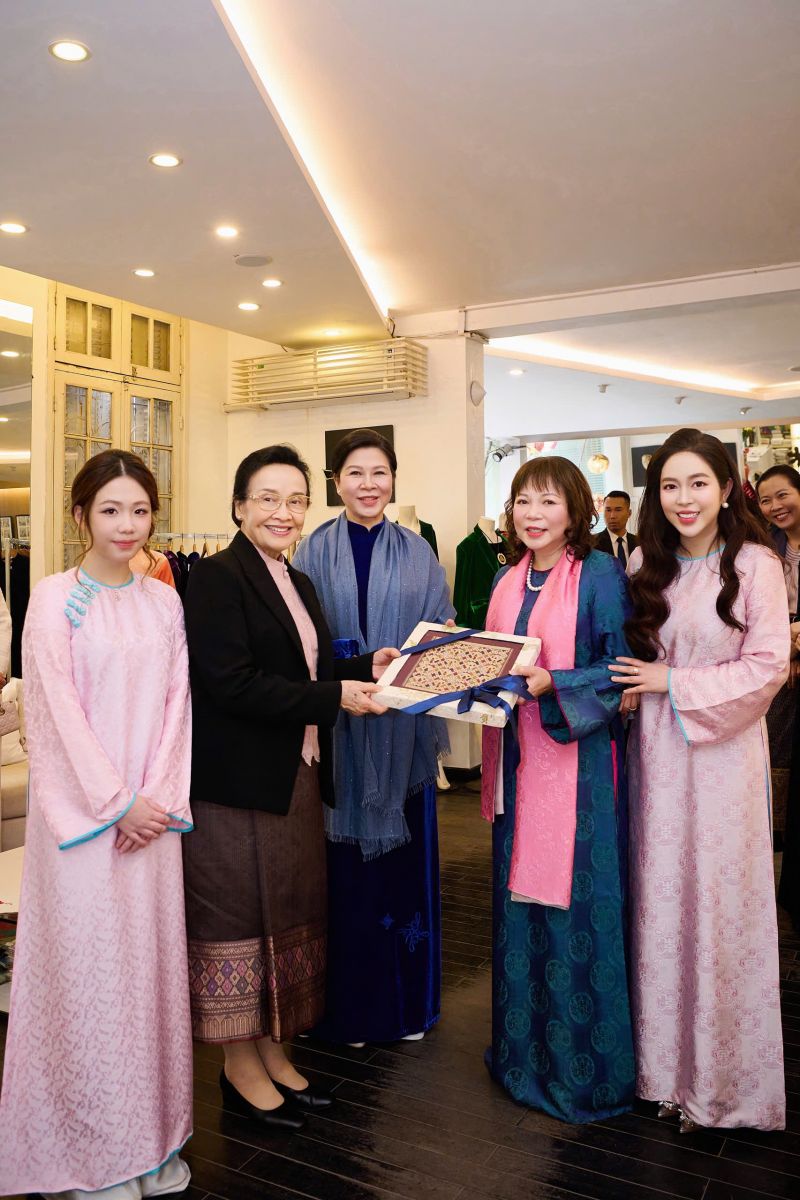
Recognition extends internationally: from being featured in The New York Times to hosting dignitaries like the First Lady of Australia. Quantitatively, it leads in heritage (55+ years), scale (1,000 m² flagship), and certified tourist service—a rare honor among family brands.
While other names like XQ lean toward theatricality and replication across cities, Tân Mỹ maintains singular control at 61 Hàng Gai, preserving both identity and intimacy. In a landscape crowded with imitators, this steadfast presence guarantees that each laundry bag is not just handmade—but storied, rare, and true.
In a world full of replicas, owning something truly handmade is a quiet form of luxury. A real embroidered laundry bag is more than utility - it’s a living story, a tactile memory, and a meaningful gift. Explore the craftsmanship of Vietnam preserved by generations at Tân Mỹ Design, where every thread honors a legacy.
Other articles
Vietnamese Silk Scarf Motifs: Meanings & Gift Choices
Square vs Long Silk Scarf: Which Makes a Better Gift?
Hand-Embroidered vs Printed Silk Scarves: Which to Gift?
_cr_720x720_cr_336x264.jpg)
Meaningful Personalized Gifts: What Makes Them Feel Truly Special



Add: 61 Hang Gai St., Hoan Kiem Dist., Hanoi, Vietnam
Hotline: +84 936631368
Email: info@tanmydesign.com